 Sahil K
Dreamforce 2026 News: What the Agentic Enterprise Means for Your Salesforce Org
Short answer: Dreamforce 2026 ran September 15 to 17 in San Francisco and centered on the “Agentic Enterprise.” The headline announcement was AIforce, an interface layer that brings Salesforce data and workflows into Claude, Slack and Lightning. Salesforce also introduced Koa, its own CRM reasoning model, and expanded Headless 360. Several pieces are still in beta or pilot.
Updated October 1, 2026
The Dreamforce 2026 news in plain English
Salesforce built the event around one idea, the Agentic Enterprise, and drew it as a four-layer stack. Data 360 holds data, metadata and memory. Customer 360 holds the business logic, processes and permissions. Agentforce supplies the agents. AIforce, new this year, sits on top as the interface. The official AIforce announcement lays out all four.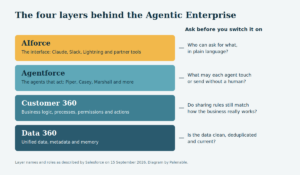
AIforce: Salesforce without opening Salesforce
AIforce is a live interface layer. Instead of asking people to navigate Salesforce’s screens, it brings Salesforce to the tools they already use. It launches with three interfaces: Claudeforce (Salesforce inside Claude), Slackforce, and Agentforce Coworker, an assistant that lives inside Lightning. The detail that matters most is permissions. Salesforce says every request runs on your existing permissions and business rules, so an agent sees only what the person asking can see, and every action routes back through Salesforce. There’s no new permissions model to learn. Salesforce also promises Zero Data Retention, meaning business data answers the question and the model provider doesn’t keep it. And anyone can describe an interface in plain language and get a live view built on your data, which Salesforce pitches as everyone getting their own UI. The first concrete piece is Salesforce in Claude. It packages a prebuilt MCP server with 37 sales skills and is in beta for all Salesforce customers. Deloitte, GitLab and Legora piloted it. On the Slack side, Slackforce adds shared live interfaces called Surfaces, a Slack CRM connection, and Slack Code for team coding sessions. Coworker is available now, and Salesforce reports that 100,000 users activated it in its first 35 days. That’s a vendor figure, so treat it accordingly. One more caveat from the release itself: pricing and packaging for AIforce are subject to change.Koa: a reasoning model built for CRM work
Koa is Salesforce’s first CRM reasoning model. It was built with NVIDIA by post-training Nemotron 3 Super on synthetic scenarios modeled on nearly three decades of CRM deployments. Salesforce says no customer data was used in training, that it controls the model weights, and that inference runs inside its own trust boundary. You can read the details in the Koa press release. The headline claim is that Koa matches or beats leading models on CRM actions, like updating an opportunity or routing a case, with three times fewer errors. Remember who ran that benchmark. Salesforce did. It’s a fair starting point and not a business case. Availability matters more than the benchmark. Koa is with select pilot customers (Formula 1, UChicago Medicine and Xero are among them), and general availability is expected in winter 2026 in U.S. regions. If you operate in the UK, the Middle East or India, ask your account team where and when Koa will be hosted before you plan around it.Headless 360: the quiet announcement that matters most
AIforce is the product face of Headless 360, which Salesforce introduced in April and expanded in August. It exposes platform capabilities as APIs, MCP tools and CLI commands. According to Codiot’s dated recap, the Data 360 MCP Server is generally available and the Headless 360 MCP Server is in open beta. Around it sits AgentExchange, a marketplace where partners including Anthropic, AWS, Google and Microsoft build interfaces and agents on the same toolkit. Our view: screens matter less every year, and the integration layer matters more. If you’re deciding where to spend Salesforce budget in the next two years, spend it on clean data, clean permissions and well-built integrations, not on redesigning page layouts.New agents, and what “generally available” really means
Salesforce showed a lineup of job-ready agents. Piper handles inbound leads, Hunter works outbound pipeline, Casey and Fin cover service, Marshall runs back-office and supply-chain work, Paige takes employee HR and IT requests, and Carter assists shoppers. Most are generally available. Hunter is in pilot with general availability planned for November 2026. Multi-Agent Orchestration is generally available, and Agent Optimizer is due in October. A generally available agent isn’t a switched-on agent. Each one acts on your data under your permissions, so the real work before go-live is deciding what it may touch, what it may send without a human, and how you’ll know when it’s wrong.Dreamforce 2026 news reality check: shipped, in beta, or still coming
A keynote doesn’t tell you what you can buy today. Some of the Dreamforce 2026 news felt new on stage but was announced earlier. Headless 360 arrived in April and Claudeforce on August 26. Here’s where things stood in the weeks after the event.| Announcement | Status | Who should care |
|---|---|---|
| AIforce | Announced. Pricing and packaging subject to change. | CIOs and Salesforce platform owners |
| Koa reasoning model | Pilot now. General availability expected winter 2026 in U.S. regions. | Agentforce teams and data-residency owners |
| Salesforce in Claude | Beta for all Salesforce customers. | Teams already working in Claude |
| Job-ready agents (Piper, Casey, Fin, Marshall, Paige) | Generally available. Hunter in pilot, general availability November 2026. | Sales, service and operations leaders |
| Multi-Agent Orchestration | Generally available. | Anyone running more than one agent |
| Hyperforce on Google Cloud (North America) | General availability expected November 2026. | Google Cloud estates |
Not sure which column your org sits in? If you’d like a second opinion on what’s worth switching on first, our certified Salesforce team can review your setup and tell you honestly what to do now and what to wait on. Talk to Palenable, no pitch deck required.
What the Dreamforce 2026 news means for your org
Your permission model just became your product
Because AIforce reuses your permissions instead of replacing them, every flaw in your sharing model shows up in more places. A sharing rule that drifted five years ago was harmless when the only way in was a screen you had to know how to navigate. It’s a different story when anyone can ask for anything in plain English. In our experience the usual suspects are profiles that were never trimmed, permission sets stacked on top of permission sets, and integration or guest users with more access than anyone remembers granting. Find those before an interface layer does.The bill is changing: Flex Credits for agent calls
On September 24, Salesforce Ben reported that successful MCP and direct API calls from registered agents will consume Flex Credits. The change comes with an Agentic Identity framework that gives each agent its own credentials instead of borrowing a user’s. That’s a sensible security step. The cost side is murkier. Salesforce hasn’t published the credit multiplier, says it will give 30 days’ notice before metering starts, and doesn’t meter sandboxes, scratch orgs or Developer Edition orgs. Existing integrations stay on their current pricing. For reference, Salesforce’s pricing page lists Flex Credits at $500 per 100,000. Without the multiplier you can’t model what an agent that makes dozens of calls per task will cost. And if you already pay a model provider such as Anthropic or OpenAI, you could end up paying twice, once to the model vendor and once in credits. Get the multiplier in writing before you connect an external agent to production.Security is a design question, not a checkbox
A week after the keynote, Zenity Labs published SalesBleed, three Agentforce vulnerabilities that allowed zero-click data theft. The entry point was a public Web-to-Lead form with a hidden prompt injection in one field. When an employee later asked their agent about the newest lead, the agent read the poisoned record and could be steered into leaking account data. Salesforce has fixed it. Zenity reported the issue on June 1, and the fixes were confirmed in August. Zenity’s wider point is the useful one: any agent that reads records submitted from outside, shows links to users, and holds tool access to sensitive data has the same ingredients. So treat anything from outside your org (web forms, email-to-case, chat transcripts) as untrusted whenever an agent reads it. Limit the tools the agent holds while it works on that data, and log what it does.Read the claims with a skeptical eye
Forrester called this Salesforce’s most complete agentic vision yet, but its analysts also questioned whether Salesforce can deliver one coherent platform rather than a set of loosely connected products (Forrester). Salesforce Ben described the AIforce launch as more piecemeal than the Agentforce reveal two years earlier. Customer stories from the stage deserve the same care: Codiot noted that projections often sit beside measurements and baselines go missing. Treat every figure as the start of a reference call, not the end of one.A 90-day plan we’d actually follow
If you run a Salesforce org and want to act on the Dreamforce 2026 news without overspending, this is the order we’d work in.- Audit permissions and sharing. Review profiles, permission sets, sharing rules and field-level security. Fix drift before any interface layer exposes it.
- Clean the data agents will read. Merge duplicates, retire stale records and fix the fields your best reps ignore. Agents reason over whatever you give them.
- Pick one workflow. Choose a high-volume process with a clear owner and a measurable outcome, such as lead qualification or case routing. Get one agent working there before anyone proposes a portfolio.
- Test in a sandbox first. Sandboxes aren’t metered for agent calls, so they’re the cheap place to learn how an agent behaves and how many calls it makes.
- Write a model and agent policy. With Koa, Claude, Gemini, OpenAI and Bedrock all on offer, decide who chooses the model for which workload, on what criteria, and where the data may go.
- Keep Lightning as it is for now. Composed interfaces are real but early. Put the effort into data and integrations, not a redesign.
Dreamforce 2026 news: who should move now, and who can wait
| Your situation | What we’d do |
|---|---|
| Clean org, already on Sales or Service Cloud with Agentforce | Switch on Coworker and pilot one job-ready agent against a single workflow now. |
| Years of customization, messy data | Clean first. Connecting agents to a messy org just spreads the mess faster. |
| Team lives in Claude or Slack all day | Try Salesforce in Claude in a sandbox and see how many calls a real task uses. |
| Regulated industry or strict data residency | Wait for Koa hosting details outside U.S. regions before planning around it. |
| Small team on a tight budget | Watch the Flex Credit multiplier. Simple automation may still be the better value. |