 Sahil K
Open Setup in your org this week and search for Agentforce. Salesforce’s developer team says the Agentforce platform is now turned on by default with Winter ’27. If nobody on your team made that call, now’s a good time to find out who’s allowed to build agents in your org.
That’s the real story of this release. The features are good. The bigger point is that Salesforce now expects agents to do actual work, not just answer questions.
Quick answer: Agentforce Winter ’27 moves Salesforce agents from answering single questions to running whole workflows. The headline additions are third-party agent orchestration, unmetered observability, a skills registry, and stronger Agent Script controls. Salesforce made the release generally available on October 12, 2026.
What actually changed: from assistant to agent
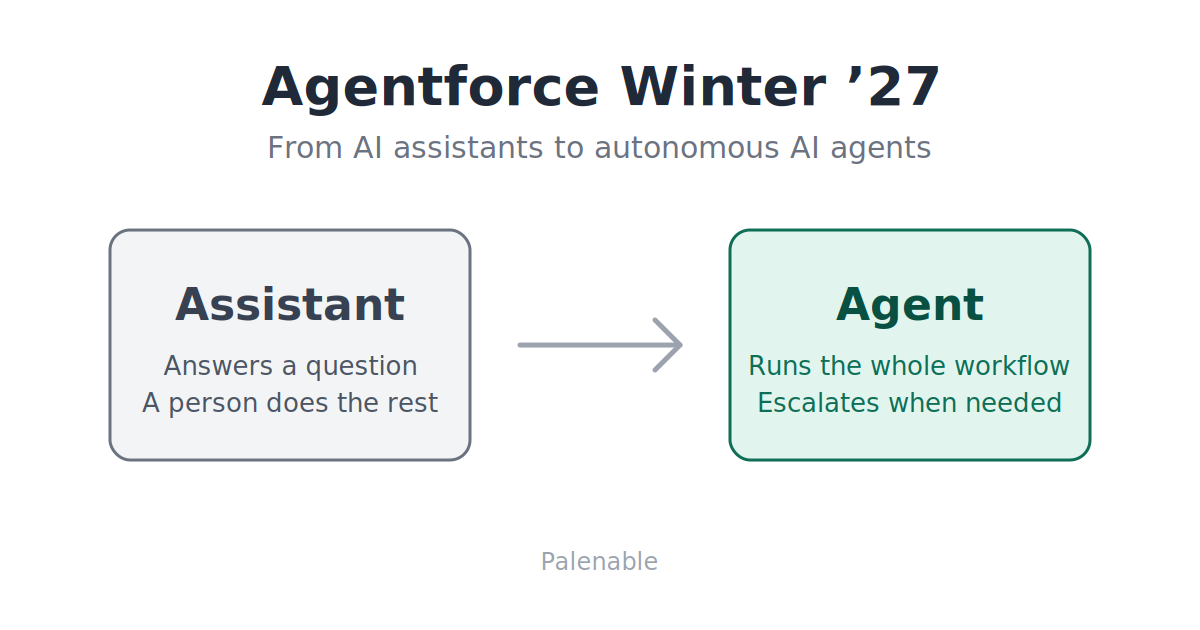
An assistant answers a question. You ask, it replies, a human does the next step.
An agent takes the next step itself. Salesforce’s own framing of Winter ’27 is that agents now run entire workflows, such as qualifying pipeline, resolving service cases, booking appointments and taking insurance claims by voice.
Salesforce’s example is autonomous scheduling with Agentforce Voice. A booking call that used to take about 15 minutes is meant to take seconds, with the agent checking availability and finding the right technician in the right territory.
Here’s our take. Winter ’27 isn’t really a release about freedom for agents. It’s about the controls that make autonomy safe enough to switch on. Observability, deterministic scripting, governed skills. That’s where the useful work is.
Agentforce Winter ’27 features that matter most
Salesforce lists dozens of updates. These are the ones we’d put in front of a CTO or operations head.
Third-party agent orchestration
Agentforce can now orchestrate agents from AWS, Azure, Google and other vendors, as long as they’re A2A-compliant. It can also sit underneath someone else’s orchestrator as a subagent.
If you already run agents from more than one vendor, this replaces a lot of custom point-to-point plumbing. If you don’t, file it away for later.
Observability without the meter
Session tracing, telemetry and the standard dashboards are now unmetered for every Agentforce customer. You can also define custom scores for things like tone, sentiment or competitor mentions. Roundups list custom scorers as beta, so treat them that way.
This matters more than it sounds. The most common reason an agent pilot stalls is that nobody can show whether it’s working. Free tracing removes the excuse.
Agent Skills and Plugins
Salesforce launched a unified registry with over 100 prebuilt skills for common platform workflows. Your team can publish its own too. Plug-ins bundle skills with the connectors and configuration an agent needs, and the Salesforce Development plug-in is already in the Claude Code marketplace.
For developers, this means less guessing about how Salesforce is “supposed” to be built.
Agent Script and multi-agent control
Agent Script picked up else if chains, JSON functions, system variables for channel and modality, and a top-level escalate statement that hands off to a human when a condition is met. Multi-Agent Orchestration is now generally available, so an orchestrator agent can pass work to specialist agents.
This is the part we like best. Deterministic escalation means “if the refund is over this amount, a person decides” can be a rule instead of a hope.
Agents as tools for other AI clients
You can expose an Agentforce agent as an MCP tool, so Claude, ChatGPT or Cursor can call it. Every call runs as the authenticated user, so sharing rules and field-level security still apply. One catch: only agents built with the new Agent Script Builder can be exposed, so legacy agents need upgrading first.
Contact center and voice
Agentforce Contact Center is now available in over 30 countries, with voice and digital channels built into the CRM. If you run a global service operation, that’s the item to read closely.
Which features are ready and which are early
| Feature | What it does | Maturity |
|---|---|---|
| Third-party orchestration | Runs agents from AWS, Azure and Google via A2A | New in Winter ’27 |
| Observability | Tracing and dashboards with no metering | Included; custom scorers in beta |
| Agent Skills and Plugins | Registry of 100+ prebuilt skills | New in Winter ’27 |
| Multi-Agent Orchestration | Hand-offs to specialist agents | Generally available |
| Agents as MCP tools | External AI clients call your agent | Needs Agent Script Builder |
| Headless Experience Layer | One widget shown in Agentforce, Claude and Slackbot | Beta |
What Agentforce costs to run
Agents don’t bill like seats. Based on a rate card dated August 31, 2026, Flex Credits cost $500 per 100,000. A standard action uses 20 credits, which is about $0.10, and a voice action uses 30 credits. Sandbox testing is discounted.
The older flat price is $2 per conversation. Flex Credits and the conversation model can’t be mixed in the same org, and the break-even sits at about 20 actions per conversation.
Here’s what that looks like. An agent that needs 8 actions to resolve a typical request costs about $0.80. One that needs 25 costs $2.50, which is more than the flat rate.
Most buyers don’t know their actions per conversation until months in. Measure it in a sandbox before you sign anything. Prices change often and sources disagree on the per-user tiers, so confirm on Salesforce’s pricing page.
[ADD PALENABLE CASE STUDY: industry, agent use case, actions per conversation measured, cost result]The part the release notes skip: why agent projects fail
Gartner predicts that over 40% of agentic AI projects will be canceled by the end of 2027 because of rising costs, unclear value or weak risk controls. It also says most vendors calling their products agentic are rebranding chatbots and assistants.
That prediction isn’t about Salesforce specifically. But it matches what usually goes wrong in the field.
The agent launches on messy data, like duplicate accounts and stale contacts, and gives confident, wrong answers. Nobody defines what “resolved” means, so there’s nothing to measure. And the pilot covers five use cases at once, so none of them gets tuned.
Also read vendor numbers with care. Salesforce reports early results of a 13% conversion lift for Agentic Commerce Search. One analyst write-up notes the measurement window and merchant count weren’t published. Useful signal, not a forecast for your store.
Agentforce Winter ’27 readiness checklist
- Check who can build. Confirm whether the platform switched on in your org and who has access.
- Pick one bounded workflow. Clear inputs, clear outputs, a measurable result. Appointment booking and case triage work. “Run sales” doesn’t.
- Clean the data first. Duplicates, owner fields and picklist sprawl will show up in agent answers.
- Model the meter. Count the actions per conversation in a sandbox, then choose the pricing model.
- Switch on observability before launch. Set your scores on day one, not after the first complaint.
- Write the escalation rules. Decide what a human always approves, then script it.
- Do the housekeeping. The CLI workaround that restores old secret output ends on October 28, 2026. From December 1, 2026, users who authenticate with SOAP login need the Use Any API Auth permission.
Not sure where your org stands on any of this? Our certified Salesforce team can run a short readiness review and tell you which workflow to start with. [Talk to our team.]
Should you adopt now or wait?
Pilot now if you have a high-volume, rules-heavy process, such as service triage, scheduling, quoting or lead follow-up. You also need a clean enough data set, and someone who owns the result.
Wait a quarter if your CRM is still being cleaned up, or you can’t yet say what a good outcome looks like. Fix the foundation. An agent on a shaky org just makes the shaky parts faster.
Either way, run one pilot, not five. We’d rather see one agent tuned for six weeks than a dozen demos.
Ready to talk it through?
Winter ’27 gives you more control over agents than any release before it. Control only helps if the design underneath is sound.
At Palenable, we handle Salesforce implementation, Apex and LWC development, integrations, data cleanup and ongoing admin support. Send us a short note on the workflow you’re considering, and we’ll tell you honestly whether Agentforce is the right fit yet.
Frequently asked questions
What is new in Agentforce Winter ’27?
Winter ’27 adds third-party agent orchestration, unmetered observability, a registry of over 100 prebuilt agent skills, Agent Script upgrades, Multi-Agent Orchestration (GA), and Agentforce Contact Center in over 30 countries. Salesforce frames it as agents running whole workflows rather than single tasks.
When was Salesforce Winter ’27 released?
Salesforce says Winter ’27 became generally available on October 12, 2026. Orgs upgrade in waves, so check the maintenance schedule for your instance.
What’s the difference between an AI assistant and an AI agent in Salesforce?
An assistant answers a question and leaves the next step to a person. An agent carries out the steps itself, such as checking availability, booking an appointment and updating the record, within rules you set.
How much does Agentforce cost?
On Flex Credits, a standard action costs 20 credits, about $0.10, at $500 per 100,000 credits. Voice actions cost 30 credits. A flat $2 per conversation model also exists. Confirm current prices on Salesforce’s pricing page.
Is Agentforce turned on by default in Winter ’27?
Salesforce’s developer team says the Agentforce platform is now on by default. Review your Agentforce settings and permissions after the upgrade so you know who can build and deploy agents.
Can Agentforce work with agents from other vendors?
Yes. Winter ’27 adds native orchestration for A2A-compliant agents, including those from AWS, Azure and Google. Agentforce can orchestrate them or act as a subagent inside another orchestrator.
Sources
- Salesforce: Top Innovations in the Winter ’27 Release
- Salesforce Developers: Developer’s Guide to the Winter ’27 Release
- Salesforce: Agentforce Observability
- Macha: Agentforce pricing explained
- Redress Compliance: Agentforce Flex Credits
- Gartner: Over 40% of Agentic AI Projects Will Be Canceled by End of 2027
- Stellagent: Salesforce Winter ’27 and the 13% conversion lift1