 Sahil K
AI is changing the way businesses interact with customers. Today, customers expect quick answers, personalized experiences, and support that understands their needs and history.
But for AI to be truly useful in a business environment, it needs more than the ability to generate responses. It needs the right context.
This is where Salesforce Agentforce and Data 360 come together.
Agentforce provides AI-powered agents that can understand requests, retrieve information, and perform configured actions. Data 360 helps bring together relevant customer data from different sources, giving those agents the context they need.
What Is Agentforce?
Agentforce is Salesforce’s platform for building AI agents that can interact with customers and employees and perform business tasks.
Unlike a traditional chatbot that mainly provides predefined responses, an Agentforce agent can understand natural-language requests, work with business information, follow configured instructions, and perform actions.
For example, a customer might ask:
“My order hasn’t arrived yet. Can you check what’s happening?”
Instead of giving a generic response, an Agentforce agent can potentially identify the customer, retrieve the relevant order information, check its status, and provide a more personalized response.
To do this effectively, the agent needs access to reliable customer data.
What Role Does Data 360 Play?
Customer information is often spread across multiple systems. Salesforce may contain accounts, opportunities, and cases, while an e-commerce platform may contain orders and delivery information. Marketing systems may contain campaign engagement and website activity.
Data 360 helps organizations connect relevant information from different sources and create a more complete view of the customer.
This connected data can support AI, personalization, analytics, and automation.
The important point is that an AI agent does not necessarily need every piece of customer information. It needs the right information for the task it is handling.
How Agentforce and Data 360 Work Together
The relationship can be understood through a simple flow:
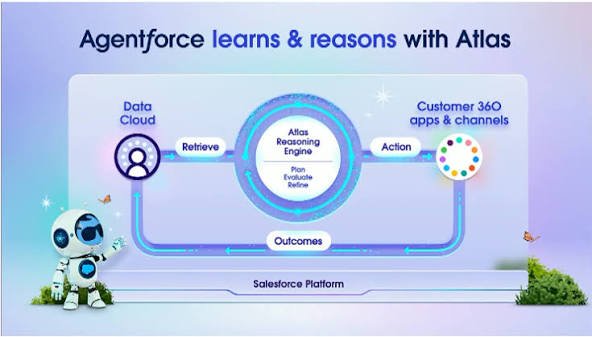
Customer → Agentforce → Relevant Customer Data → Agentforce → Response or Action
Imagine a customer asks:
“Where is my latest order?”
Agentforce first understands the request and determines that it needs order information. Relevant data can then be retrieved, such as:
- Customer: Rahul Sharma
- Order: #10045
- Product: Laptop
- Status: Shipped
- Expected Delivery: October 4
Using this context, the agent can respond:
“Your latest order, #10045, has been shipped and is expected to arrive on October 4.”
The interaction can go beyond providing information. Depending on the configuration, the agent may also create a case, update a record, retrieve additional information, start a workflow, or escalate the conversation to a human.
This is what makes an AI agent different from a basic chatbot: it can connect a conversation with business data and actions.
A Practical Customer Service Example
Consider an electronics company where a customer says:
“My laptop is not working properly. I bought it recently. What can you do?”
Instead of asking the customer to provide all the details again, an Agentforce agent with access to relevant customer information could potentially find:
- Customer: Rahul Sharma
- Product: Dell Laptop
- Purchase Date: September 15
- Warranty: Active
- Previous Case: Battery issue
The agent can use this information to provide a more relevant response and guide the customer through the next step.
The value is not just generating a response. It is using customer context to make the interaction more useful and connected to the business process.
Where Can This Combination Be Used?
Agentforce and Data 360 can support a variety of business scenarios.
- Customer Service: Order tracking, case creation, product support, returns, and appointment scheduling.
- Sales: Lead qualification, account research, opportunity information, follow-ups, and product recommendations.
- Marketing: Audience segmentation, personalized experiences, campaign insights, and customer engagement.
- Commerce: Product discovery, order tracking, recommendations, and returns.
- Employee Support: HR processes, IT support, company policies, and internal knowledge.
What This Means for Salesforce Developers
For Salesforce developers, AI adds another layer to traditional Salesforce development.
Skills such as Apex, LWC, Flows, APIs, integrations, and data modeling remain important. At the same time, developers increasingly need to understand how AI agents access data, use instructions, invoke actions, and work within security and business rules.
Instead of building only traditional Salesforce experiences, developers may increasingly build solutions where an Agentforce agent understands a user’s request and invokes the appropriate Salesforce action.
Bringing It All Together
The relationship between Agentforce and Data 360 can be summarized simply:
Data 360 → Customer Context
Agentforce → Intelligence + Action
Together, they enable more context-aware AI experiences.
The bigger idea is not simply “AI + more data.” It is “AI + trusted context + business actions.”
When Agentforce has access to the right context, it can move beyond simply answering questions and become part of the actual business process.
Conclusion
Agentforce and Data 360 demonstrate how AI becomes more valuable when it is connected to trusted business data.
Data 360 helps bring relevant customer information together, while Agentforce uses that context to understand requests, provide responses, and perform configured actions.
As Salesforce continues to expand its AI capabilities, connecting trusted customer data with AI agents will become increasingly important for creating personalized customer experiences and improving business processes.