 Sahil K
Welcome to NextGen Tech. This cornerstone mega-guide is designed to be your definitive blueprint for the next decade of technological evolution. We are moving beyond the era of the smartphone and the simple search engine, entering a convergence period where artificial intelligence, quantum mechanics, and synthetic biology intersect.
Pillar 1: The AI Evolution — From Generative to Agentic
We have spent the early 2020s marveling at Generative AI—models that can write poetry, generate images, and write code. But generation is just the first step. The true paradigm shift of this decade is Agentic AI.
 What is Agentic AI?
Unlike conversational models that wait for a prompt, an agentic workflow is autonomous, goal-oriented, and capable of multi-step reasoning. You don’t ask it to “write an email.” You ask it to “research the top three competitors in our space, summarize their pricing models, draft an outreach strategy, and execute the email campaign by Tuesday.”
- Sub-agents: Complex tasks are broken down and delegated to specialized sub-agents. One agent gathers data, a second checks it for factual accuracy, a third formats it, and a fourth executes the action.
- Neuro-symbolic integration: Future models won’t just guess the next word based on probability; they will combine neural networks (for pattern recognition) with symbolic logic (for hard rule-based reasoning).
The Economic Impact: The transition to agentic AI means we are no longer just augmenting human workflows; we are building parallel, digital workforces. Software is transitioning from a “tool you use” to a “colleague you manage.”
Pillar 2: Spatial Computing — The Post-Screen Era
For decades, human-computer interaction has been constrained to glowing rectangles in our hands or on our desks. Spatial computing shatters that paradigm, mapping digital information directly onto our physical environment.
The Hardware Convergence
The bulky VR headsets of the past were stepping stones. The real breakthrough lies in lightweight, all-day Augmented Reality (AR) glasses. These devices utilize micro-OLED displays, waveguides, and advanced eye-tracking to project high-fidelity holograms into your field of view without isolating you from the real world.
- Industrial Maintenance: A technician looking at a jet engine sees the exact CAD overlay, torque specifications, and step-by-step repair manuals anchored directly onto the physical parts.
- Medical Surgery: Surgeons receive real-time biometric data, 3D MRI overlays, and AI-assisted incision guides projected directly onto the patient’s anatomy during procedures.
- Everyday Navigation & Social: Turn-by-turn walking directions painted on the sidewalk; language translation appearing as subtitles beneath a speaker in real-time.
Pillar 3: Quantum Computing — Leaving the Lab
Quantum computing leverages the principles of quantum mechanics to process information in ways classical computers physically cannot. Where classical bits are 0 or 1, quantum bits (qubits) can exist in a superposition of states, allowing them to evaluate massive numbers of possibilities simultaneously.
Where Quantum Changes Everything
| Industry | The Classical Bottleneck | The Quantum Solution |
|---|---|---|
| Pharmaceuticals | Simulating complex molecule interactions is mathematically impossible for large proteins. | Quantum systems can naturally simulate molecular behavior, reducing drug discovery from decades to months. |
| Logistics | Global supply chain routing involves too many variables for perfect optimization. | Instantly calculates the absolute most efficient routing for thousands of ships and trucks. |
| Cryptography | Modern encryption (RSA) relies on the difficulty of factoring massive prime numbers. | Shor’s Algorithm running on a stable quantum computer can crack current encryption in hours. |
Pillar 4: Advanced Robotics and Embodied AI
AI is no longer confined to the cloud; it is getting a physical body. “Embodied AI” allows models to interact with the physical physics of the real world.
The Humanoid Form Factor
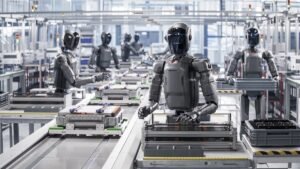
Why build robots that look like humans? Because our entire world—stairs, door handles, tools, and vehicles—was designed for the human form factor. Instead of retrofitting factories and homes for wheeled robots, we are building robots that can navigate our existing infrastructure.
- Sim-to-Real Learning: Robots are trained in massive, physics-accurate digital simulations. They can attempt a task millions of times in simulation before the software is downloaded into a physical robot.
- The Labor Shortage Solution: Initially deployed in highly structured environments like automotive manufacturing and logistics warehouses, advanced humanoids are gradually scaling down in cost and up in safety.
Pillar 5: Bio-Computing and Synthetic Biology
Silicon has physical limits. Moore’s Law is slowing down because we can only make transistors so small before quantum tunneling causes them to fail. The next frontier of computing might not be made of metal and glass, but of organic matter.
DNA Data Storage
Humanity generates exabytes of data daily, and traditional magnetic tape and server farms are energy-intensive and degrade over time. DNA is nature’s ultimate hard drive.
- Density: All the world’s data could theoretically fit into a volume of DNA the size of a shoebox.
- Longevity: While a hard drive might last 10 years, DNA preserved in cool, dry conditions can remain readable for hundreds of thousands of years.
Conclusion: Adapting to the NextGen Era
The convergence of these five pillars will rewrite the rules of economics, labor, and human interaction. The companies and individuals who thrive in this new era will not necessarily be those who understand the deepest mechanics of quantum physics or neural networks, but those who are highly adaptable and can creatively integrate these new tools into existing workflows.