 Sahil K
The Digital Real Estate War: A Comprehensive Guide to Cybersquatting
Introduction: The Invisible Battlefield
Cybersquatting is a serious issue in today’s digital economy. In fact, it has become a major digital real estate battle for brands worldwide. Cybersquatting occurs when someone registers a domain name that matches a trademark or brand with bad intent. As a result, businesses face domain disputes and brand reputation damage. Moreover, these conflicts often lead to expensive legal action. Therefore, companies must understand the risks and act early to protect their digital assets.
Typically, a cybersquatter registers a domain that is identical or very similar to a well-known business, public figure, or trademarked brand. However, their goal is not to build a real website. Rather, they intend to:

1.Defining Cybersquatting: What Is It Exactly?
At its core, cybersquatting—also called domain squatting—is the act of registering or using a domain name in bad faith to profit from another company’s trademark. In other words, the person registering the domain has no legitimate rights to the name. Instead, they aim to benefit from someone else’s brand value.
Typically, a cybersquatter registers a domain that is identical or very similar to a well-known business, public figure, or trademarked brand. However, their goal is not to build a real website. Rather, they intend to:
-
Extort: Sell the domain back to the rightful owner at an inflated price.
-
Phish: Redirect users to a fraudulent site to steal credentials.
-
Siphon Traffic: Earn ad revenue from “misspelled” traffic.
-
Malicious Defamation: Use the domain to tarnish a brand’s reputation.
2.The Taxonomy of Domain Infringement
Not all cybersquatting looks the same. To run a successful blog or protect a brand, one must understand the various sub-categories:
-
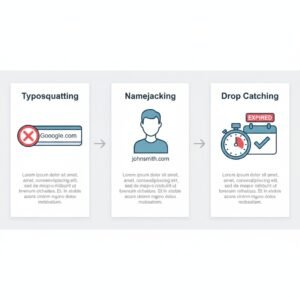
Typosquatting (The “Fat Finger” Error)
This is the most common form. Squatters register common misspellings of popular sites.
- Example: Registering Gooogle.com or Facecook.com.
- The Strategy: Capitalizing on users who make typing errors to show them ads or install malware.
-
TLD Squatting (Top-Level Domain)
A brand might own YourBrand.com, but the squatter registers YourBrand.net, YourBrand.co, or the newer YourBrand.ai.
- The Strategy: Forcing the original brand to buy all extensions to prevent brand dilution.
-
Namejacking
This involves registering the personal names of celebrities, politicians, or viral internet personalities before they can do so themselves.
- The Strategy: Exploiting the individual’s fame for traffic or resale.
-
Identity Theft / Drop Catching
When a legitimate business forgets to renew their domain, it “drops.” Squatters use automated scripts (bots) to buy the domain within milliseconds of it becoming available.
- The Strategy: Holding a company’s own history and SEO ranking for ransom.
3. The Legal Framework: ACPA and UDRP
If you are a victim of cybersquatting, you aren’t defenseless. There are two primary global pillars of protection:
-
-
-
The Anticybersquatting Consumer Protection Act (ACPA)
-
-
A U.S. federal law that allows trademark owners to sue squatters in court.
-
-
-
Pros: Can result in monetary damages (up to $100,000 per domain).
-
Cons: Expensive, slow, and requires the squatter to be under U.S. jurisdiction.
-
Uniform Domain-Name Dispute-Resolution Policy (UDRP)
-
-
Managed by ICANN and often adjudicated by WIPO (World Intellectual Property Organization). This is an administrative process, not a lawsuit.
To win a UDRP case, a complainant must prove three things:
-
-
- The domain is identical or confusingly similar to a trademark.
- The registrant has no rights or legitimate interests in the domain.
- The domain was registered and is being used in bad faith.
-
4.Case Study: The 2024-2025 JioHotstar Saga
In a landmark recent example, a young developer in India registered JioHotstar.com anticipating a merger between Reliance (Jio) and Disney+ Hotstar.
-
-
- The Conflict: The developer asked for £93,000 to fund his education at Cambridge.
- The Lesson: This case highlighted the “grey area” of domain speculation. While the developer claimed it was for education, the legal consensus often views “registering a domain specifically to sell it to a trademark holder” as a definition of bad faith.
-
5.Defensive Strategies for Modern Brands
Prevention is significantly cheaper than litigation.
Step 1: Proactive Registration
When launching a brand, do not just buy the .com. Buy the common misspellings and the major extensions (.net, .org, .info, and local TLDs like .in or .uk).
Step 2: Trademark Your Name
A domain name is not a trademark. To win a legal battle, you must have a registered trademark. This is the “deed” to your digital property.
Step 3: Domain Privacy and Auto-Renewal
Enable “Auto-Renew” on your registrar (like GoDaddy or Namecheap) and keep your credit card information updated. Use Domain Privacy (WhoisGuard) to hide your contact details from scrapers who target owners.
Step 4: Use a Corporate Registrar
Large companies should use registrars like MarkMonitor or CSC, which are designed for brand protection rather than individual hobbyists.
6.Domain Flipping vs. Cybersquatting
However, cybersquatting specifically targets existing brands to exploit their reputation. Therefore, it is considered illegal in many jurisdictions.
-
-
- Domain Flipping: Buying a generic word like Pizza.com or Coffee.io and waiting for the market value to rise is a legitimate business.
- Cybersquatting: Specifically targeting someone else’s brand name to cause harm or profit from their work is illegal.
-
7.Comparative Analysis Table
| Feature | Typosquatting | Namejacking | Identity Theft (Drop) |
|---|---|---|---|
| Target | High-traffic URLs | Famous Individuals | Expired Business Domains |
| Primary Goal | Ad Revenue/Malware | Resale/Reputation | Ransom/SEO Siphoning |
| Legal Standing | Clearly Illegal | Variable (Jurisdiction dependent) | Hard to fight (due to negligence) |
| Difficulty to Fix | Moderate | High | Extreme |
8.Conclusion: The Future of Digital Identity
As we move forward, new blockchain domains like .eth and .sol are emerging. Consequently, the cybersquatting landscape is evolving. Because decentralized domains lack central regulation, disputes may become more complex.
Ultimately, your domain name represents your brand identity. Therefore, protecting it should be a priority. If you fail to secure your digital property today, someone else may claim it tomorrow.